What Nobody Tells You About Dance Team Clinic Etiquette
This guide breaks down the insider etiquette that coaches and instructors are watching for, from how you position yourself in the room to what you do when it's not your turn. If you want to walk in confident and make the decision easy, this is your prep guide.
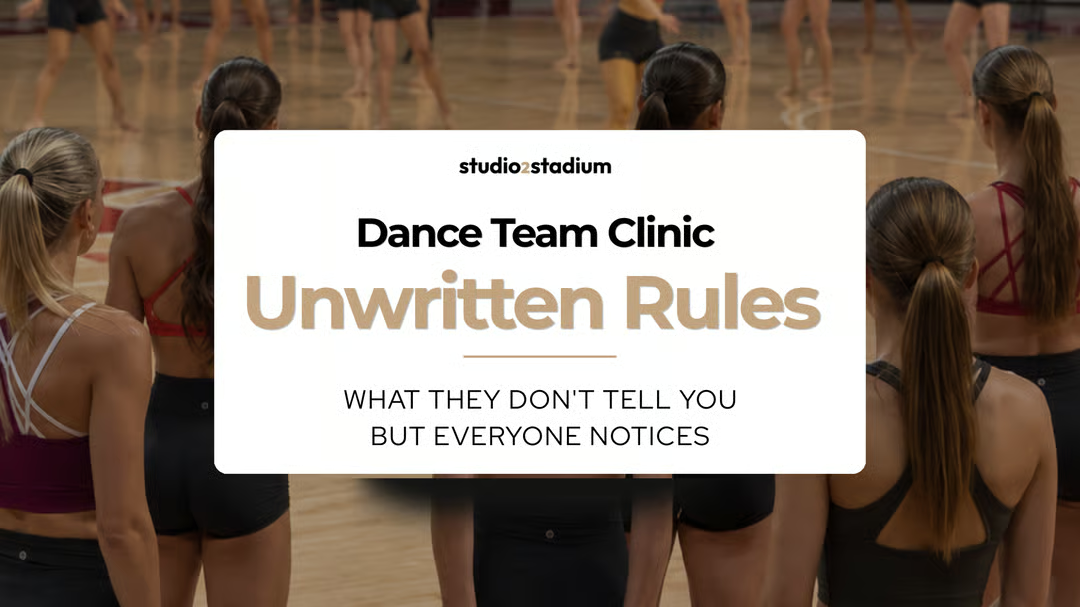
Most dancers show up prepared, they've drilled the combo, they refined their technique, they've got their hair done and their outfit ready. And all of that matters. But the truth is, the things that truly separate dancers at a clinic often have nothing to do with whether you hit the eight count perfectly.
There's an entire layer of evaluation happening that nobody hands you a sheet for. Coaches and instructors are watching how you move through the room, how you respond when things get hard, what your face does when the camera isn't on you, and what kind of energy you bring to the people standing next to you.
This is that layer. The unwritten rules. Consider this your insider guide.
Where You Stand Says Everything About Your Confidence
Let's start with something so simple it almost feels too obvious but it isn't, because most dancers get it wrong.
Where you position yourself in the room the moment you walk in tells a story. If you always drift to the back, blend into the crowd, and make yourself easy to overlook, that's exactly what will happen. You will be overlooked.
Now, this isn't about being aggressive or pushing people out of the way. It's about being intentional. Rotate your spot throughout the clinic. Start in a visible position. Move to a different angle when you rotate. Make sure that at some point during the session, you are in the eyeline of the people who are evaluating you.
Here's something most dancers don't think about: instructors often take mental notes during the very first run-through. That first impression of where you are standing, how locked in you look, and how much space you're taking up in the room can set the tone for how they see you for the rest of the day. Don't waste it by being invisible.
Constant Questions Can Work Against You
This one stings a little, but it's important.
Asking questions is not inherently a bad thing. Curiosity and a desire to get it right are genuinely great qualities. But there's a time and place and in the middle of a clinic, class or instruction is usually not it.
When a dancer repeatedly stops the group, calls out mid-combination, or raises their hand every time they miss a count, it signals a few things that aren't great: that they're not watching closely enough, that they need more individual attention than the setting can provide, or that they're not yet comfortable learning by doing.
The dancers who stand out do this instead: they try it first, even if they're not sure. They watch the dancers around them. They use their body to figure it out rather than relying on someone to tell them every step. And then if they still need clarification after a few runs, they ask at an appropriate moment, like during a water break or after the group finishes.
That kind of self-sufficiency and awareness is exactly what team environments require. Show them you have it.
Your Phone Etiquette Is More Visible Than You Think
This one seems obvious. And yet, it keeps coming up.
Silence your phone before you walk into the clinic. Not on vibrate. Silenced. And then put it away.
Here's why this matters beyond the basic courtesy of it: your phone is a distraction magnet. Even if you're not actively scrolling, having it nearby pulls your attention the moment it lights up. And in a clinic setting, where you need to be absorbing choreography, reading the energy of the room, and staying mentally engaged every single second, that half-second of distraction is a real cost.
There's also the optics. Coaches notice when dancers are on their phones on the sidelines. It communicates that you're somewhere else mentally and that's the last impression you want to leave.
The one exception? If an instructor explicitly gives permission to film a combination for learning purposes. Even then, film it once, put the phone down, and get back to work.
You Are Always Being Watched. Even When You Think You're Not
This is the one that catches people the most off guard.
Most dancers understand that they're being evaluated when they're on the floor performing. What they don't realize is that the evaluation never actually stops.
The moments in between, when you're catching your breath on the side, when you're waiting for the next group to finish, when someone else is getting a correction, those moments are part of the picture too. Coaches are human. They're taking in the full room. And the dancer who is visibly disengaged, whispering to a friend, sitting down, or staring at the floor during a transition registers differently than the dancer who stays locked in.
What does "locked in" look like when it's not your turn? You're watching. You're mentally running the choreography. You're keeping your body warm. You're present in the room even when the spotlight isn't on you. That kind of sustained focus is rare, and it gets noticed.
Cliques Are More Visible Than You Think
If you're attending a clinic with friends or teammates, this one is especially for you.
It is completely natural to gravitate toward people you know. It's comfortable. It's familiar. But from the outside, from a coach's perspective, a tight-knit group that only talks to each other, only stands next to each other, and only cheers for each other reads as closed off. It can actually be a quiet red flag in team settings, because teams require adaptability and openness.
Here's a simple, low-pressure way to change this: position yourself next to someone who is already on the team. If this is an open clinic or audition setting where current team members are present, make the effort to introduce yourself, stand near them, and be warm and genuine. It shows social confidence. It shows you can integrate. And it absolutely gets noticed by the people watching.
You don't have to abandon your friends entirely, just expand your circle for the day. Be the dancer who seems at home in any corner of the room.
How You Receive a Correction Is One of the Most Important Things You'll Do All Day
If a coach or instructor takes the time to give you a correction, that is a good thing. It means they're invested enough in what they see to try to improve it. The dancers who get zero feedback are often the ones who blended in too much to notice.
But here's where dancers lose points without realizing it: the reaction.
The reaction that coaches remember, the one that makes them want to invest in you further goes like this: you make eye contact, you nod to show that you genuinely understood what was said, you say thank you, and then you immediately physically do the correction. Not in your head. Not on a half-hearted next run. Right then.
That sequence matters. It tells a coach that you're coachable, that you don't take feedback personally, that you're quick to apply new information, and that you have enough self-awareness to prioritize growth over ego. That is the kind of dancer every team wants more of.
What to avoid: looking around to see if others got the same note (it reads as defensive), shutting down emotionally (coaches feel it), and saying you understand without actually adjusting (they'll see it on the next run).
Encouraging the People Around You Is Part of the Audition
This is the one most people have never considered and it might be the most powerful one on this list.
When it's not your turn, and you're watching another group go, what do you do? Most dancers watch passively. The great ones cheer.
A genuine "that was amazing" or a clap when someone nails a combo costs you nothing. But what it communicates to every coach in the room is priceless: it shows that you are the kind of teammate who lifts others. That you're not so focused on your own performance that you lose sight of the people around you. That you bring positive energy even when there's nothing in it for you.
Team dynamics are a real part of what coaches evaluate, especially at the dance team level, where you will be spending hours together in practice, at games, community service, travel and more. They are not just looking for the best individual dancer. They are looking for the best team member. Showing them that you're already thinking like one is a major advantage.
The Small Things Are the Real Audition
Here's the truth, and it's the thing I want you to walk away remembering:
The combination is the baseline. Technique is the entry point. Every dancer in that room has been working on those things. What truly separates who stays and who goes home is everything surrounding the combination, the awareness, the attitude, the coachability, the presence.
The most memorable dancer in the room is the one who makes every moment count. The one who rotates to be seen. Who stays off their phone. Who thanks their instructor and fixes it immediately. Who cheers for the person next to them like they mean it.
Be that dancer. Walk in knowing the unwritten rules. And make the decision easy for them.
You've got this!